
neuroconversion
neuroconversion
Case Study — VortexHaus
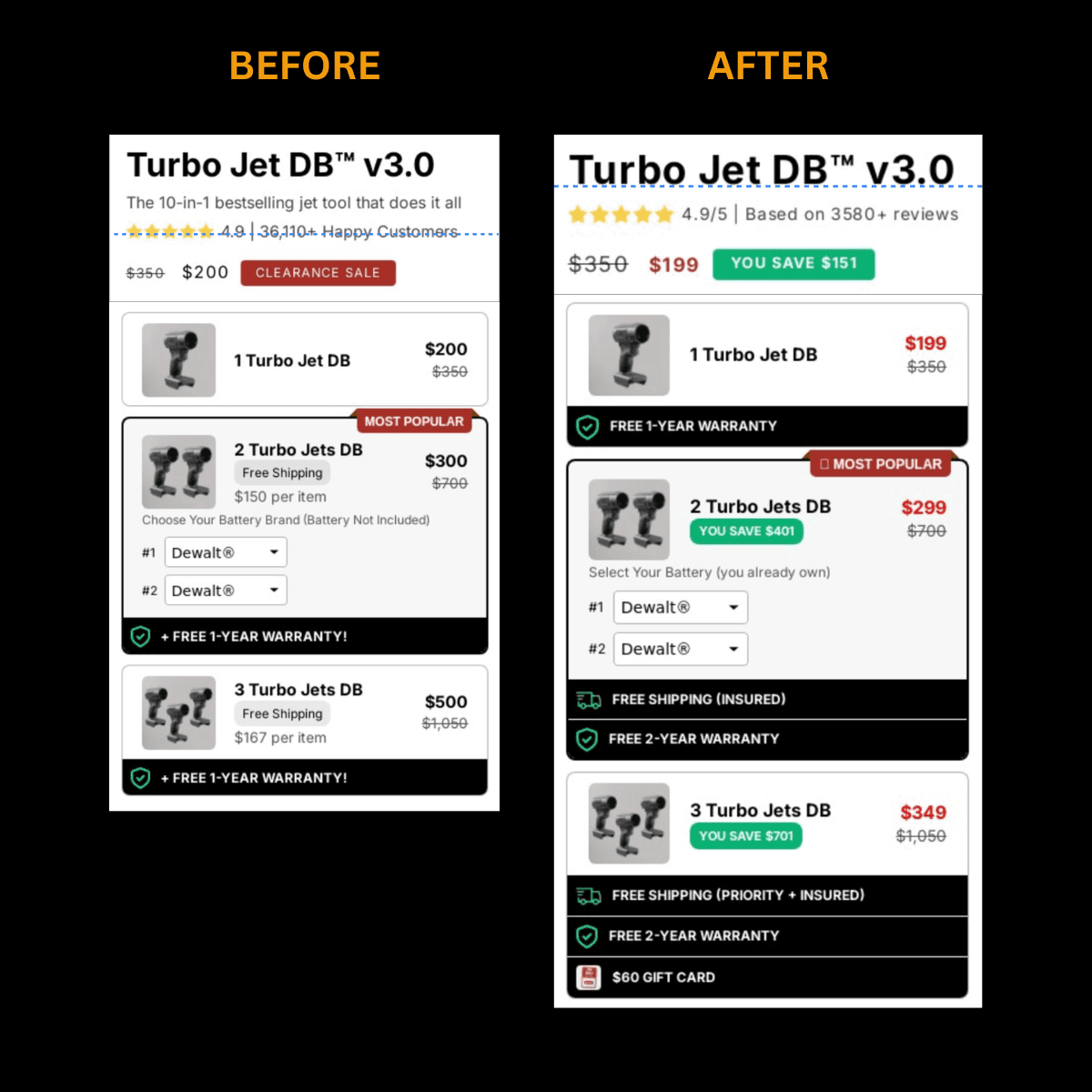
VortexHaus had the traffic. They had the product. They had 3,500+ five-star reviews. What they didn't have was an offer section that could close. 53% of buyers were picking the cheapest option and leaving. One above-the-fold restructure flipped that number to 12%.
+23.5%
Conversion Rate
+19.4%
Revenue Per Visitor
+88%
Multi-Unit Order Rate
01 — The Problem
The Turbo Jet DB was a proven winner — 4.9 stars, real demand, heavy paid traffic from Meta and Google. But the product page was underperforming and nobody could figure out why. Average order was stuck below 2 units on a page built for bundles. Over half of all buyers picked the single-unit option and left.
The product wasn't the problem. The offer architecture was.
Savings were invisible
Crossed-out price. Sale price. No savings callout. The customer had to subtract $200 from $350 in their head to feel the deal. Mental math kills conversions. Worse — "CLEARANCE SALE" framed a premium tool as leftover stock. The savings were massive — over $150 on a single unit — but the page never said that out loud.
Value didn’t scale
Buy 2, get free shipping and a warranty. Buy 3, get... free shipping and a warranty. Same perks. No escalation. The bundle pricing barely rewarded buying more — $300 for two, $500 for three. The tiers existed but neither the prices nor the incentives gave the customer a reason to move up. There was no ladder — just three doors that all led to the same room.
Friction at the point of commitment
"Choose Your Battery Brand (Battery Not Included)" — dropped right into the 2-unit buying flow. At the exact moment the customer should be clicking Add to Cart, the page introduced a new decision and a new worry. That’s not helpful information. That’s a conversion leak.
02 — The Solution
The original page had a great deal and did everything possible to hide it. $350 crossed out, $200 next to it, figure it out yourself. We flipped that. Every change was built around one principle: if the customer can't feel the savings instantly, the savings don't exist.
Red price anchoring with explicit dollar savings. We added a bold red “YOU SAVE $151” badge to every tier. Not a percentage. Not a vague “sale” label. A concrete dollar amount, in red, impossible to scroll past. This wasn't a design choice — it was a psychological one. Research from Oxford, Drexel, and Babson found that men perceive prices displayed in red as significantly cheaper — in one experiment, 66% cheaper than the identical price in black.[1] The Turbo Jet DB's audience is overwhelmingly male. Red prices aren't decoration for this demographic. They're a heuristic trigger that short-circuits deliberation and amplifies perceived value.
$200 → $199: left-digit pricing. A $1 reduction that changes the leftmost digit from 2 to 1 isn't a $1 saving — it's a category shift. Research shows consumers encode price magnitude starting from the leftmost digit before they finish reading the rest.[2] A large-scale analysis of retail scanner data found that shoppers react to a 1-cent increase past a 99-ending as if it were more than a 20-cent jump.[3] On a $200 product, dropping to $199 pulls the perceived price into the $1XX range. Same economics, different psychology.
Aggressive bundle repricing with escalating savings badges. The original charged $300 for two and $500 for three. We dropped those to $299 and $349 — hitting below key left-digit thresholds on both.[4] But the real move was the savings delta between tiers: $151 saved on one, $401 on two, $701 on three. Each badge in red. Each jump so large that staying on the single-unit tier felt like throwing money away. The gap did the selling.
Stacking incentives that rewarded commitment. The original gave the same perks at every tier. We built an actual incentive ladder: 1 unit gets a free 1-year warranty. 2 units adds insured shipping and a 2-year warranty. 3 units adds priority shipping, a 2-year warranty, and a $60 gift card. Every step up visibly unlocked something new. Every step down meant losing something.
Friction reframe on the battery selector. “Choose Your Battery Brand (Battery Not Included)” became “Select Your Battery (you already own).” Same dropdown. Completely different psychology. One creates a worry. The other removes it.
03 — The Results
295 transactions. 7-day controlled A/B test via Shoplift. Order-level data. No modeled projections — just what actually happened.
The 2-unit tier went from 14% of orders to 52%. Customers weren't debating whether to buy — they were debating how many. Cart value before discounts held steady, meaning the bigger discounts were funded by volume, not margin. More units. More revenue. No margin erosion.
On a high-traffic page running significant paid spend, a 19.4% RPV lift compounds fast.
🔒
The psychological triggers behind each change — dollar savings anchoring, the left-digit price drop, the incentive ladder framework, and the friction reframe — are in the full teardown, available to DTC CRO Meat subscribers.
Get the Full Breakdown →04 — Conclusion
Teams will spend months optimizing ad creative, testing headlines, tweaking checkout flows. Then they'll copy-paste a default offer section template and call it done. The ATF — the 800 pixels where a customer decides what to buy and how much — gets treated as a layout task.
It's not. It's where the money is made.
The difference between a $200 order and a $300 order isn't price sensitivity. It's value visibility.
VortexHaus had everything except an offer structure that communicated value clearly enough to shift behavior. One test fixed that. CVR up 23.5%. RPV up 19.4%. Multi-unit orders nearly doubled.
Not from discounting harder. From making the savings impossible to miss.
Sources
[1]Puccinelli, N. M., Chandrashekaran, R., Grewal, D., & Suri, R. (2013). Are men seduced by red? The effect of red versus black prices on price perceptions. Journal of Retailing, 89(2), 115–125.
[2]Thomas, M. & Morwitz, V. (2005). Penny wise and pound foolish: The left-digit effect in price cognition. Journal of Consumer Research, 32(1), 54–64.
[3]Strulov-Shlain, A. (2023). More than a penny’s worth: Left-digit bias and firm pricing. Review of Economic Studies, 90(5), 2612–2645.
[4]Sokolova, T., Seenivasan, S., & Thomas, M. (2020). The left-digit bias: When and why are consumers penny wise and pound foolish?. Journal of Marketing Research, 57(4), 771–788.
If you're a 7–9 figure DTC brand and your ATF hasn't been structurally optimized, you're leaving money on every session.
Book a Free Audit →